The Brush of the Future: My First Month with AI Art
For over a decade, my world was defined by the smell of linseed oil, the texture of stretched canvas, and the physical weight of a palette laden with color. I was a traditional painter, trained in the classical methods, believing that true art required the friction of physical media and the slow, deliberate accumulation of human labor. When the first waves of AI-generated imagery began to crash across the digital landscape, my reaction was one of visceral rejection. I saw these creations not as art, but as a synthetic imitation—a product of cold calculation devoid of the human spirit. "It has no soul," I argued, joining a chorus of voices that felt their life's work was being devalued by a machine that could render a masterpiece in seconds.
Yet, as the technology progressed, I found myself unable to look away. The images were becoming more complex, more evocative, and more disturbing in their competence. I realized that my dismissal was born out of fear rather than understanding. So, I made a pact with myself: I would spend a month immersing myself in this new medium, not to replace my traditional practice, but to understand the enemy. What I discovered shattered my preconceptions and opened a door to a new way of seeing.
My first attempts were clumsy. I expected the AI to be a magic oracle that would translate my vague thoughts into perfect visuals. Instead, I was met with a wall of chaotic, often grotesque interpretations of my prompts. I quickly realized that prompting was not simply typing a description; it was a new form of dialogue. It required a precise vocabulary, an understanding of style directives, and a willingness to iterate endlessly. I spent hours refining my words, learning how to guide the algorithm's attention, and discovering that the prompt itself was a composition of ideas.
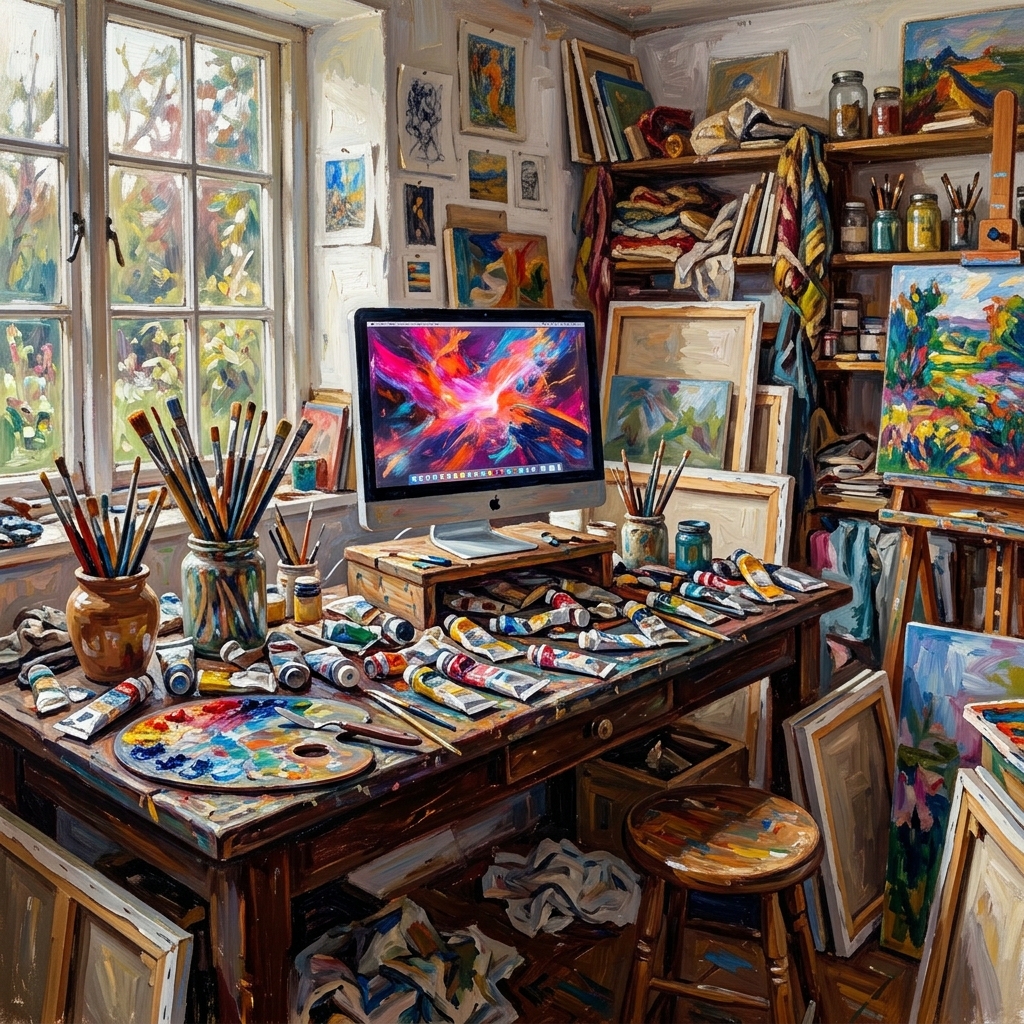
The studio, once a sanctuary of quiet contemplation, became a hub of digital experimentation. I found myself surrounded by a duality: on one hand, the familiar tools of my trade—brushes caked with dried paint, tubes of pigment, the smell of turpentine; on the other, the glowing screen of my computer, a window into a latent space of infinite visual possibilities. This juxtaposition felt jarring at first, but soon, a synergy began to emerge. I was no longer just looking at the screen; I was using it as a mirror for my imagination. I began to feed my own sketches into the system, asking it to iterate on my compositions. It was like having a studio assistant with a thousand arms and a memory that spanned the history of art.
The breakthrough came in the third week. I was struggling with a composition for a large-scale landscape painting. I wanted to capture the feeling of a forest in the early morning light, but the arrangement of elements felt stagnant. I decided to feed my sketches and color notes into the AI, asking it to generate variations based on my own style. The results were a revelation. The algorithm suggested compositions I had never considered, playing with light and shadow in ways that felt both alien and deeply familiar. It didn't give me a finished painting, but it gave me the spark I needed. I took those digital suggestions back to the physical canvas, and the resulting work was one of the most dynamic pieces I had ever created.
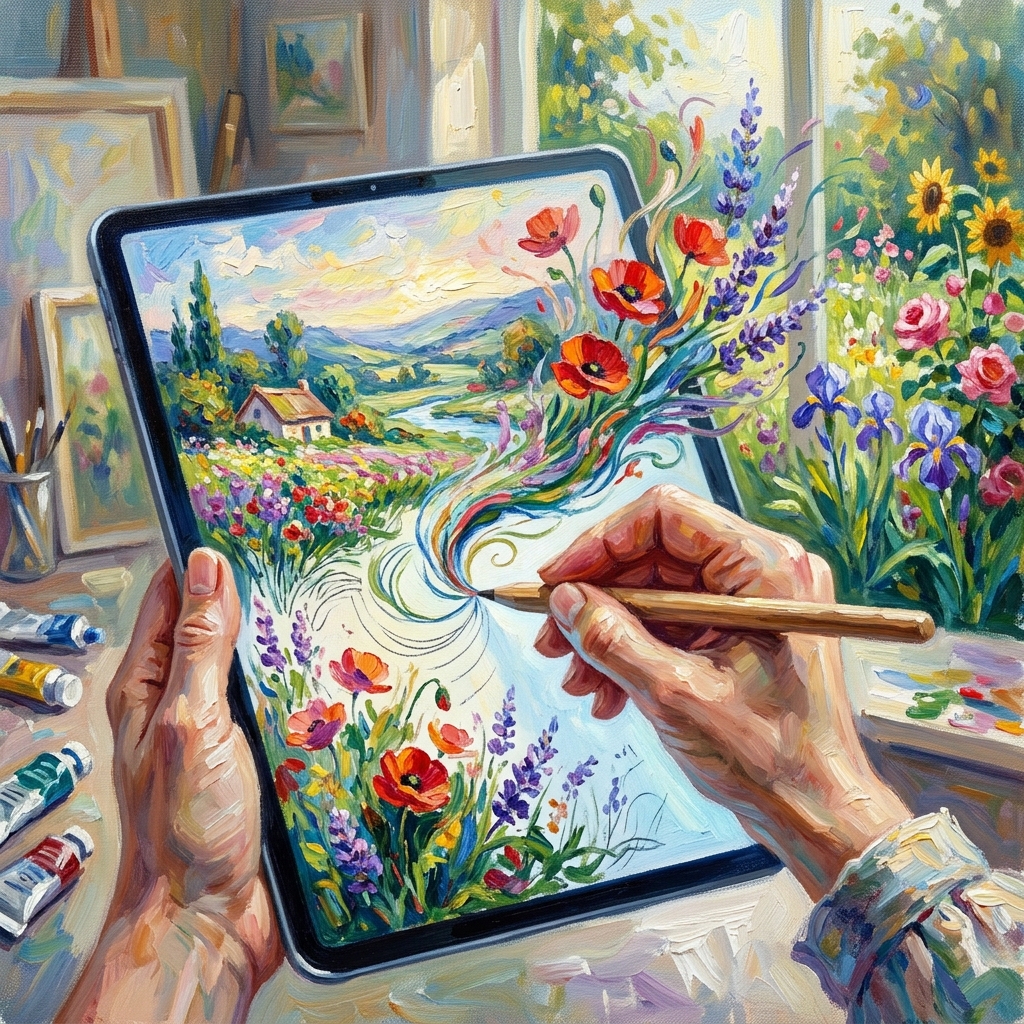
This experience forced me to redefine my understanding of the 'human touch'. We often conflate the value of art with the labor required to produce it. But the true essence of art lies in the vision, the intent, and the emotional resonance of the creator. The AI is a powerful tool for exploration, but it lacks intentionality. It does not feel the morning light or understand the weight of memory; it simply processes data. It is the human artist who brings meaning to the output, who curates, refines, and gives it a voice.
Now, I view AI not as a replacement for the brush, but as an expansion of it. It is the camera of the 21st century. When photography was invented, many believed it would spell the death of painting. Instead, it freed painting from the burden of representation and gave birth to modern art. I believe generative AI will do the same. It will push us to explore new realms of abstraction, conceptual depth, and collaborative creation. My studio is no longer divided between the digital and the physical; they have merged into a single, expanded canvas where the future of art is being painted.
The reaction from my peers has been mixed, to say the least. Some have embraced the possibilities, seeing it as I do—a new tool in the artist's arsenal. Others remain vehemently opposed, viewing it as a betrayal of traditional craftsmanship. I understand their concerns. There is a risk that the market will be flooded with low-effort, algorithmically generated content that devalues the work of human hands. But I believe the solution is not to ban the technology, but to elevate our own practice. We must learn to use these tools with intention, to infuse them with our own unique perspectives and emotions. The future of art is not a battle between humans and machines, but a collaboration that could lead to a renaissance of human creativity.